血浆外泌体标志物预测非小细胞肺癌免疫治疗效果的研究
肺癌中国发病率和死亡率均居首位的恶性肿瘤。近年来,以PD-L1单抗为代表的免疫疗法广泛应用,并在部分患者中表现出显著抑制肿瘤进展的效果。然而,由于肿瘤细胞存在高度异质性,仅约20–30%的肺癌患者对免疫治疗敏感,且目前缺乏可靠指标预判疗效。血浆中肿瘤细胞分泌的EV为寻找评估免疫治疗预后的诊断标志物提供了可能。它们携带特征性的“分子画像”(molecular profile),可间接映射肿瘤细胞的异质性,为评估免疫治疗敏感性提供窗口。
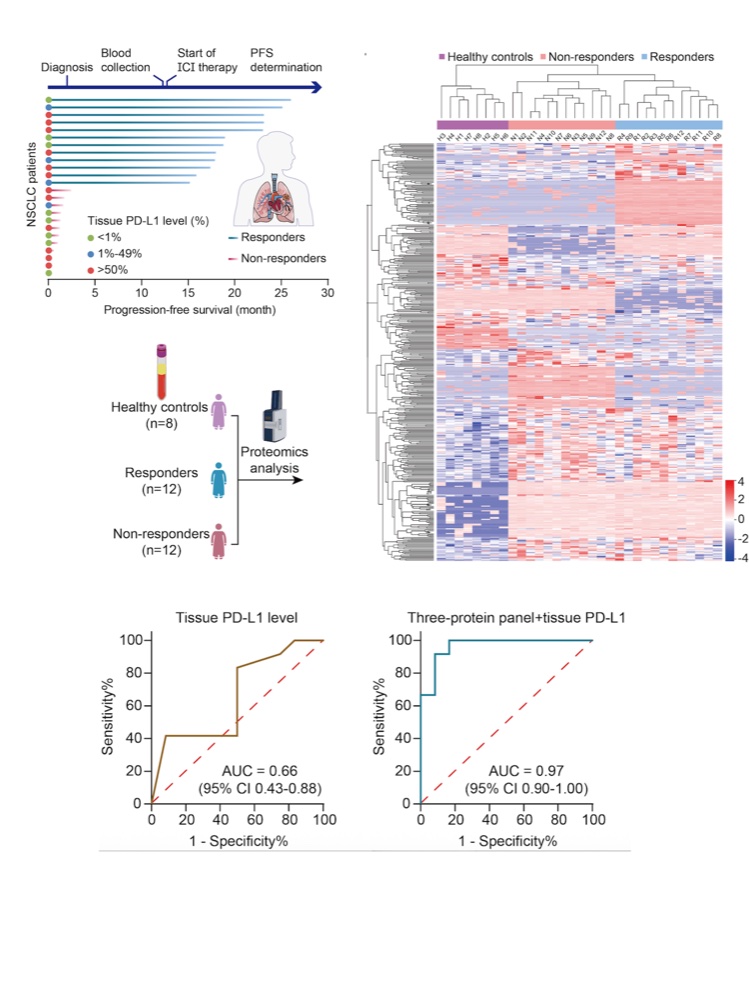
近年已有研究报道血浆外泌体中某些miRNA或蛋白质可较好区分非小细胞肺癌免疫治疗的响应与非响应人群,但受限于超速离心等繁琐分离技术,这些标志物难以临床落地。我们课题组开发的DAC EV分离技术有望突破该局限。利用DAC平台,我们从非小细胞肺癌患者队列血浆中提取肿瘤来源EV亚群,并通过4D-DIA质谱平台全面分析蛋白质组表达差异。结合患者免疫治疗后的临床随访数据及1–3年肿瘤进展与生存期信息,发现血浆EV中近千种蛋白质的表达水平可较好区分响应与非响应个体。进一步分析识别出一组补体蛋白 (C1q、C4A、C5),其在两组间的表达量差异显著,所构建的预测组合 (predictive panel) 的ROC曲线下面积 (AUC) 可达0.9以上。这些补体蛋白是炎症通路和适应性免疫的重要成员,我们后续将深入研究它们在肿瘤微环境中影响免疫治疗进程的分子机制。同时,鉴于DAC方法操作简便、成本较低,具备较高转化潜力,我们将在更大规模临床队列中验证该血浆EV标志物预测非小细胞肺癌免疫治疗响应的应用价值。
Plasma exosomal biomarkers for predicting immunotherapy response in non-small cell lung cancer
We explore the potential of plasma-derived EVs as biomarkers to predict the efficacy of immunotherapy in non-small cell lung cancer (NSCLC). While immunotherapies such as PD-L1 blockade have improved patient outcomes, reliable indicators for predicting therapeutic response remain limited. Using our DAC-based EV isolation platform, we analyze tumor-derived EV subpopulations from plasma samples of NSCLC patient cohorts through 4D-DIA mass spectrometry. Integrating clinical follow-up and survival data, our studies identified distinct proteomic signatures that differentiate responders from non-responders, including a panel of complement proteins (C1q, C4A, C5) with predictive accuracy exceeding an AUC of 0.9. Ongoing work investigates the mechanistic roles of these proteins in the tumor immune microenvironment and evaluates their clinical utility in larger patient cohorts, aiming to establish EV-based biomarkers as practical tools for guiding immunotherapy decisions.