高效、简便、低成本的EV分离纯化新方法开发
目前实验室常用的EV分离方法包括超速离心、密度梯度离心、尺寸排阻色谱和免疫亲和捕获等。但这些方法或依赖昂贵专业设备(如超速离心机、色谱柱),或需耗时较长、对操作经验要求高。即便藉此获得特异性和敏感性良好的EV标志物,其临床转化与推广应用仍面临诸多困难。
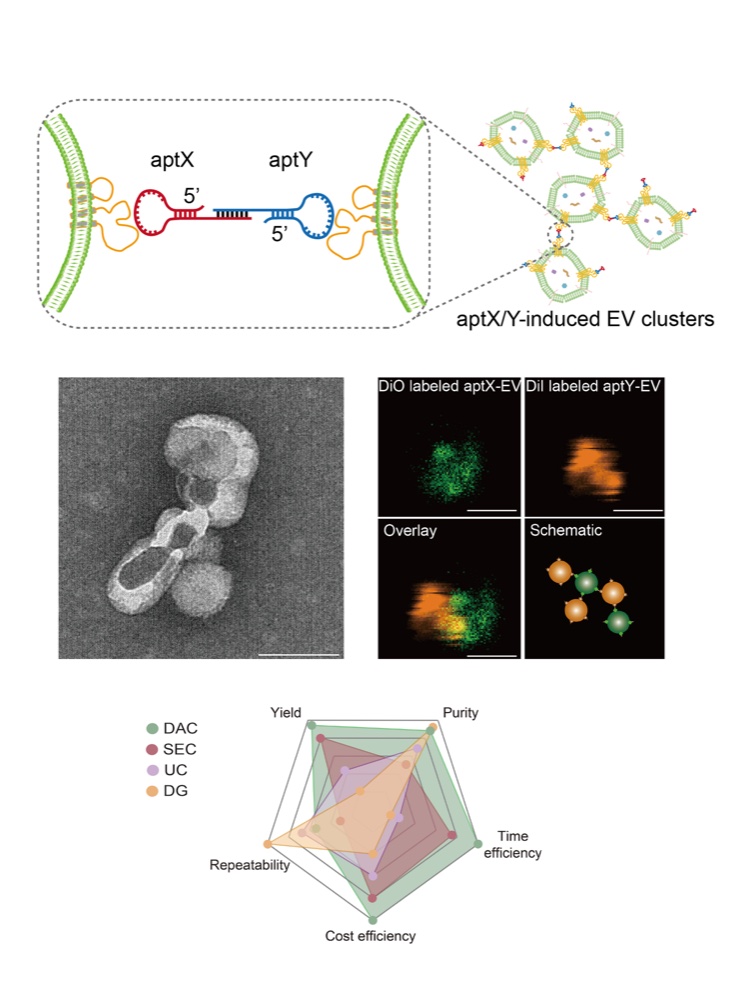
我们近期开发出一种基于核酸适配体的新型EV分离方法(Divalent Aptamer Clustering, DAC),可从血浆、尿液、泪液、组织及细胞上清等多种样本中高效、高纯度地分离EV。该方法利用特殊设计的二价适配体结构,特异性识别并结合EV表面特征蛋白CD63,促使EV形成团簇(clusters),从而显著增大其尺寸,使得通过普通过滤技术即可实现快速、简便的分离。
为优化效率,我们通过建立扩散限制团簇聚集(Diffusion-Limited Cluster Aggregation, DLCA)模型,模拟团簇形成过程及时间--尺寸演化曲线,为该方法的理论基础提供支持。进一步与当前广泛使用的EV分离方法进行多维度比较显示,DAC不仅在回收率和纯度上优于三种主流方法,在操作时间、成本及可重复性等方面也显著优于其他EV分离技术。
这一创新方法的意义不仅在于为EV研究领域提供了更简洁高效的工具,更具备较高的临床转化潜力。无需特殊仪器,该方法可便捷地开发为诊断试剂盒,应用于多种疾病场景。
Development of innovative, efficient, and accessible EV isolation technologies
We aim to establish new methods for EV purification that overcome the limitations of traditional approaches such as ultracentrifugation, density gradient centrifugation, and size exclusion chromatography. To this end, we developed a novel method termed Divalent Aptamer Clustering (DAC), which enables high-purity EV isolation from diverse biological samples including plasma, urine, tears, tissue, and cell culture supernatants.
DAC utilizes specially designed bivalent aptamers that recognize EV surface protein CD63 and induce controlled EV clustering, allowing rapid isolation via simple filtration. Supported by diffusion-limited cluster aggregation modeling, this technique demonstrates superior performance over conventional methods in recovery rate, purity, reproducibility, and cost-effectiveness.
The DAC platform not only advances EV research but also holds strong potential for clinical translation through its adaptability to diagnostic kit development.